
Most people think career progression is all about hard work and hoping someone notices.
But behind closed doors? There’s a little tool doing a lot of the deciding.
It’s called the 9-box grid. And if you work in a corporate environment, there’s a good chance you’ve already been placed on it — even if you’ve never seen it.
So let me show you how it works, and more importantly, what it means for your career.
What Is the 9-Box Grid?
It’s a simple 3×3 matrix that maps people against two things:
- Performance – how well you do your job right now
- Potential – how ready you are to take on more complex or senior roles
Here’s what it looks like:
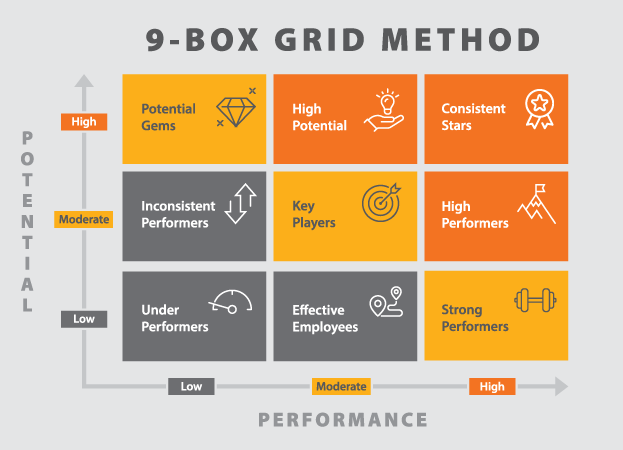
Each box means something different. And depending on where you land, the conversations about you behind the scenes can be wildly different…
Why This Actually Matters
If you’re in that top-right box — high performance and high potential — then you’re considered a future leader. You’re the one getting development budget, stretch projects, and fast-tracked for promotion.
But maybe you’re smashing your targets… and still not moving up?
You might be in the bottom right — high performer, low potential. That’s where a lot of steady, skilled professionals end up. Especially introverts, specialists, and people who don’t shout about what they do.
You’re seen as dependable… but not promotable.
That usually means:
- You’re overlooked for leadership programmes
- You don’t get stretch projects
- You might even be at risk if there’s a restructure
And then there’s the top-left box — high potential, low performer. Often these are early-career employees, big personalities, or people who just look like leaders. They’re seen as “one to watch” even if they haven’t proved it yet.
That’s where things can feel unfair. But it’s still the system a lot of companies use.
So Who Decides Where You Land?
Usually it’s your manager during performance and talent reviews.
They rate you on performance and potential — and then HR and leadership calibrate scores across teams to keep things “fair”.
But let’s be honest — it’s not always objective.
It’s influenced by:
- How well-known you are
- How confident you come across
- Whether you’re seen as “strategic”
- How visible you are in meetings or cross-functional work
So it’s not just about how good you are at your job — it’s also about how people see you.
How to Shift Where You Sit on the Grid
You can’t control everything. But you’re not powerless either.
Here’s how you can start shifting perceptions:
1. Talk about impact, not activity
Don’t just say what you do — explain the difference it makes.
Instead of: “I run monthly reports”
Try: “I redesigned our reporting process and cut turnaround time by 30%.”
2. Solve problems beyond your own team
Fixing your team’s problems is expected. Fixing cross-functional issues? That’s potential.
3. Be visible where decisions get made
Get involved in pilot projects, working groups or anything strategic. People need to see what you’re capable of — not just hear about it second-hand.
4. Ask better questions in your 1:1s
Skip the “Am I doing OK?” chat. Ask:
“What would I need to show to be considered ready for the next level?”
It shows ambition — and gives you something concrete to work on.
5. Be a builder
Build systems. Build relationships. Build others up. People who improve the way the business works — not just deliver their own tasks — are the ones who get noticed.
It isn’t perfect
The 9-box grid isn’t perfect. It’s not always fair.
But it’s how a lot of promotion, succession planning, and yes — even redundancy — decisions get made.
You don’t need to play politics.
But you do need to understand the game.
Because being great at your job isn’t always enough.
You need to be seen as someone the company can’t afford to lose.
So — where do you think you land right now?
And what would it take to shift up a square?
Need help with your job search?
Not sure what’s wrong with your CV?
Get your Free CV Score and see how your CV performs across 5 key areas.
Want detailed feedback on your CV?
Get my Full CV Review with unlimited reviews for 12 months.
Want me to personally review your CV?
Book a Personal Video CV Review
Want help with your whole job search?
Get the No-Nonsense Job Search System
Just need the basics? Download my free CV Writing Guide & Template.
Job Search & Career Advice Worth Reading
Join 38,000+ professionals receiving practical recruiter insights, CV advice and interview tips every week. No recycled career clichés. Just honest advice to help you get hired.
Get My Free NewsletterDo you really need to tailor your CV for every job application?
October 13, 2026 • UncategorizedCV AdviceJob Search
Your CV Lists Responsibilities. It Needs to Show Your Impact.
October 5, 2026 • CV AdviceJob Search
How to Write Achievements on Your CV Without Making Them Sound Ridiculous
October 5, 2026 • CV AdviceJob Search